The next chapter is more complex than the last.
Extending a proven AI advantage into the specialty work that still needs people.
AI is already delivering at scale. The next gains are in more complex work.
What it means: Intact has industrialized AI where data is structured and high-volume. Initial coverage is done. What's next: scaling into more complex, judgment-heavy workflows — a different kind of problem.
Deep and proven — this is where the C$220M is being generated today.
The next opportunity isn't more models. It's applying AI to the work around the decision — a hypothesis, not a claim we know your next use case.
Sources & Intact's own read on specialty ▾
Chapter-one record: ~600 models run by 600+ specialists; C$220M+ recurring annual benefit to date, on a trajectory toward C$500M; stated ambition to be "the best AI insurance shop in the world."
On specialty: Intact's specialty leadership describes AI in the book as early and still human-driven, and notes specialty "requires a more tailored application" than personal and commercial lines.
Insurance Business — Intact CEO on data & AI (Mar 2026) ↗ · Insurance Business — specialty AI (Mar 2026) ↗The next value is in the workflows AI hasn't reached yet.
Specialty underwriting brings together documents, multiple systems, external information and human judgment — a multi-step workflow, which is exactly what agentic AI can orchestrate.
Value
What business outcome could improve — capacity, speed, service, loss ratio?
Complexity
Where does the work need multiple steps, systems and judgment?
Feasibility
Can it be built with Intact's data, systems and governance?
Economics
Does the value justify the build and run cost?
Why it matters: the gap suggests an opportunity to understand what's limiting growth or economics in the flat segment.
Is the constraint capacity, risk selection, loss performance, workflow friction, or something else? Discovery determines that — we don't presume it, and we don't claim agentic AI is the fix. This shows why looking for a value pool is worthwhile, not that we've found it.
What we know
Public Intact facts — the AI record, the named workflow, the two-thirds / one-third split.
What we infer
Hypotheses from the workflow shape and analogous agentic deployments.
What we validate
The actual workflow, the baseline, and the economics — jointly, in discovery.
Lyzr provides the platform to build, deploy and scale agentic workflows.
Intact brings the business problem, workflow, data and expertise. Lyzr provides the platform — and keeps humans in control.
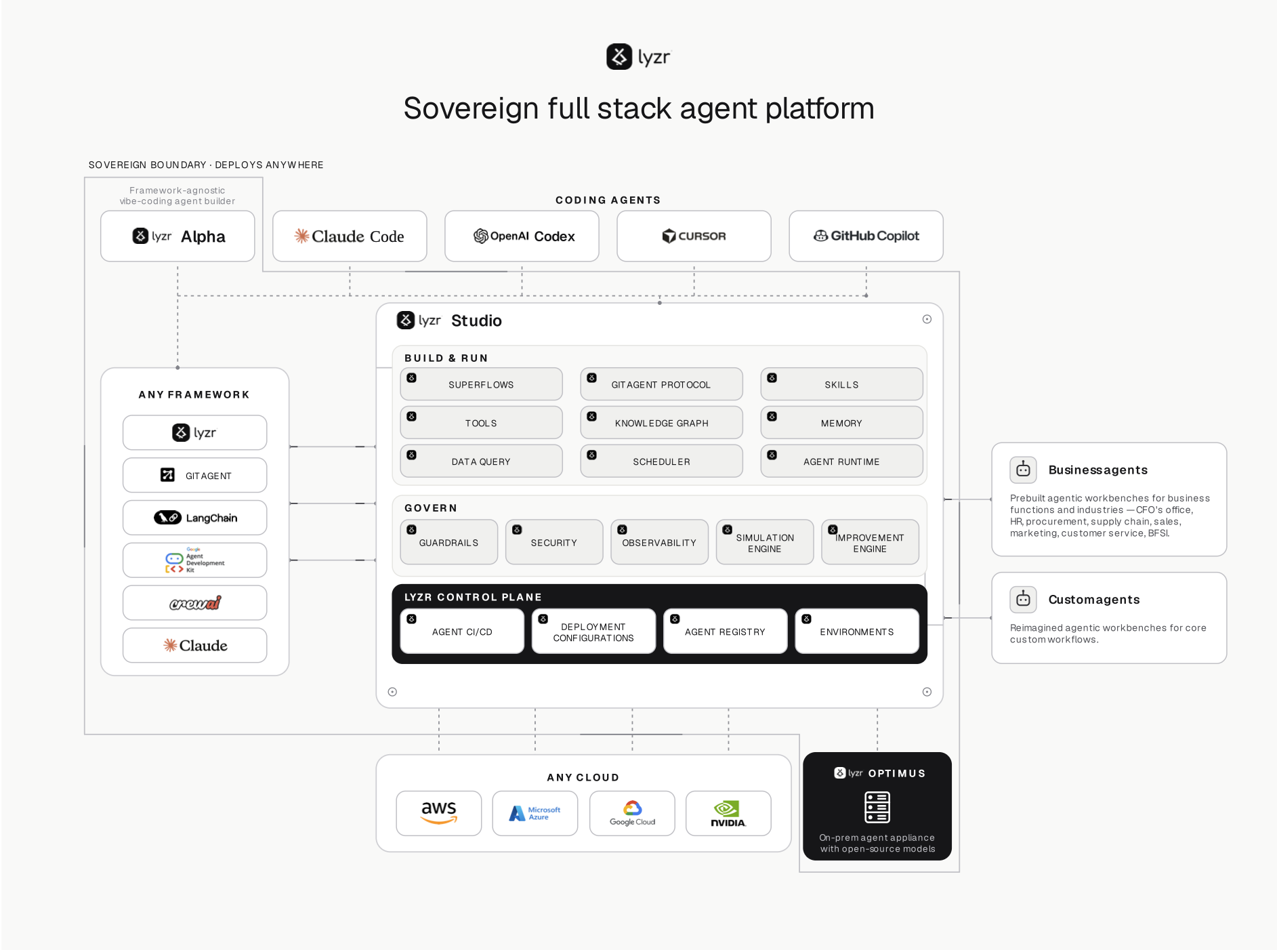
How it fits: Intact's data, systems and knowledge → the Lyzr platform (agents, orchestration, tools, governance) → the underwriting workflow → human review and decisions. It complements Intact's existing AI and Azure environment — it doesn't replace it.
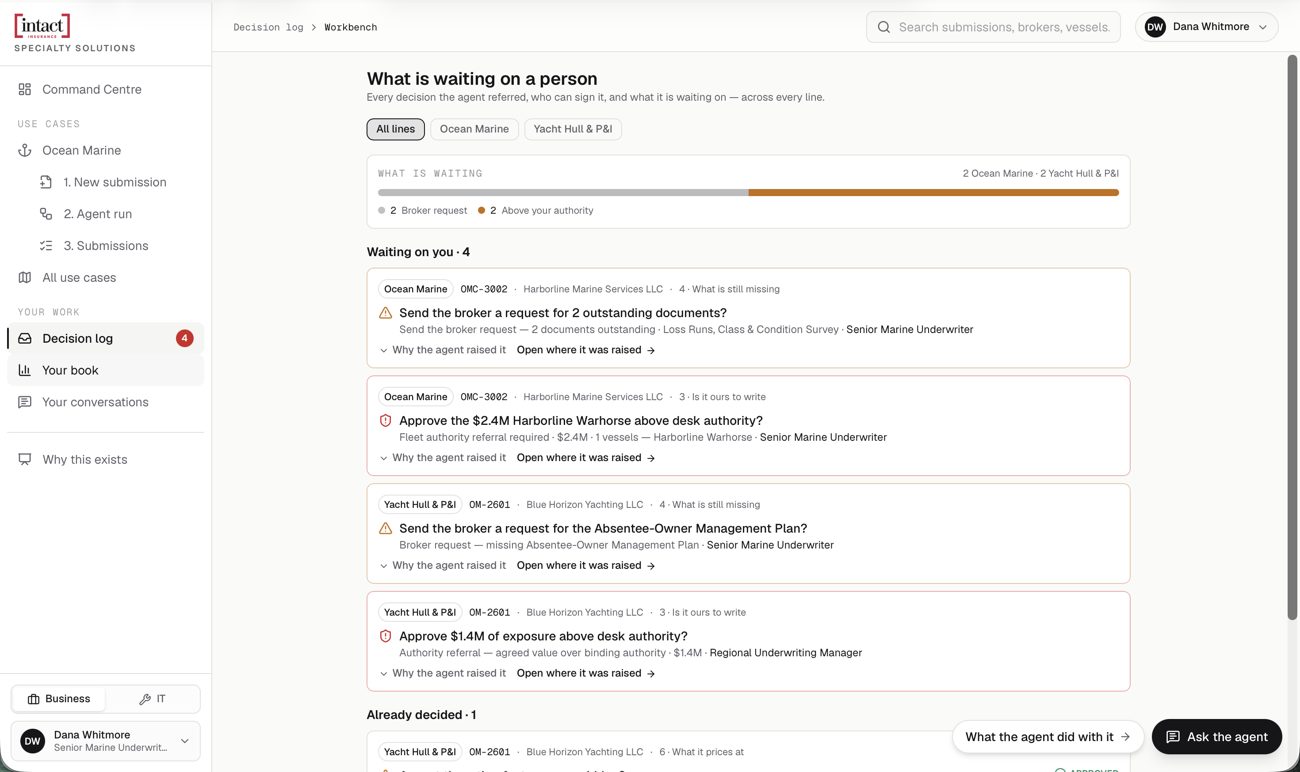
A focused workspace where the agent reads the packet, reconciles documents, checks completeness and drafts a risk narrative — with pricing on a deterministic engine, not the model. The underwriter decides; the agent never posts on its own.
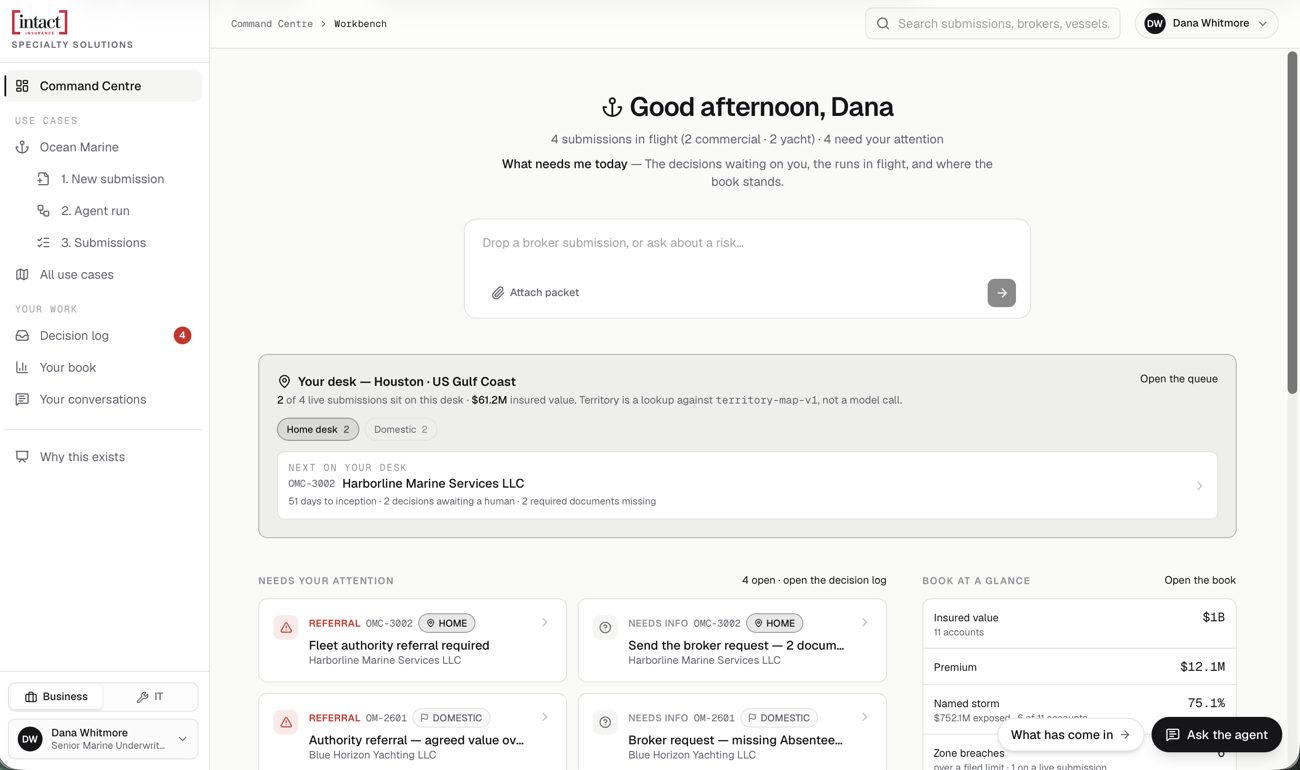
Controlled
Guardrails and governance are built into the workflow — fairness & bias checks on by default.
Traceable
Every output traces to its source document; figures come from a deterministic engine, not the model.
Human-led
Agents recommend; authorized people decide. Above-limit exposure routes to a senior signer.
Enterprise-ready
Runs in your Azure environment and works with your existing systems and security controls.
Intact owns the capability. Lyzr accelerates the build.
Intact owns
- The business problem
- The workflow
- The data
- The knowledge
- The agents & resulting capability
- Operations
Lyzr provides
- The platform
- Orchestration
- Integrations
- Governance
- Accelerators
Why not build it yourselves? Intact already has deep AI capabilities. Lyzr accelerates a different layer — agentic orchestration across complex workflows — without requiring Intact's AI team to build the platform layer from scratch.
WTW — a live enterprise deployment across five systems of record, human-in-control, with a full audit trail. Pattern evidence — not an underwriting performance claim. A reference Intact has already spoken with.
More on the WTW pattern ▾
An orchestrated multi-agent workflow ingests and reconciles every data point across five systems and hands the operator a single confidence-scored recommendation. Nothing posts without human approval; every action is captured in a full audit trail; the workflow improves from operator corrections; security is Azure-native. Engagements that start with one workflow expand into more over time.
Lyzr case study — WTW B2C billing operations ↗We don't hand you an ROI number. We build yours from Intact's baseline.
The value, TCO and ROI questions you're asking can't be answered credibly without your operating baseline. Five steps, run jointly, ending in agreed pilot economics.
Identify
Select the workflow — the highest-value, highest-feasibility opportunity.
Baseline
Understand current volume, effort, time, cost and quality — from Intact's own data.
Design
Determine what the agentic workflow changes — and where the human stays in control.
Quantify
Estimate value, implementation cost and TCO — Intact's own ROI, not a vendor's estimate.
Validate
Agree pilot economics and success criteria — and what clears TPRM, ARB and Responsible AI.
The questions discovery answers ▾
- Which workflows carry the greatest manual effort?
- Where is cycle time concentrated, and where does rework occur?
- Which parts of the submission process need the most human judgment?
- Where do underwriters spend time gathering or reconciling information?
- Where does capacity constrain growth, or decisions stall on fragmented information?
- What quality or consistency issues exist today?
- Which systems hold the required information, and what data is accessible?
- What governance constraints apply (TPRM, ARB, Responsible AI)?